Smart battery packs
Build the board into the pack. Each pack reports its own cells, charge, health and cycle count to any aircraft it is plugged into.

Capabilities
Event-based visionNewCameras that see fast movement without blur.Battery and powerBattery boards that report every cell to the machine.Long-range linksRadio links that keep a drone connected far from its pilot.Embedded hardwareElectronics built for heat, shaking and weather.Products
MODB-BB 6S–12SMonitor, balancer and fuel gauge for large drone packs.MODB-SB 3S–8SCompact BMS with on-board current sensing to 100 A.MODL-Core pMDDL2450Carrier board for Microhard pMDDL IP-mesh radios.All productsWhich battery board do I need?Battery boards for your applicationCompany
HomeAboutTell us your problemSmart battery management · drones, robots and beyond
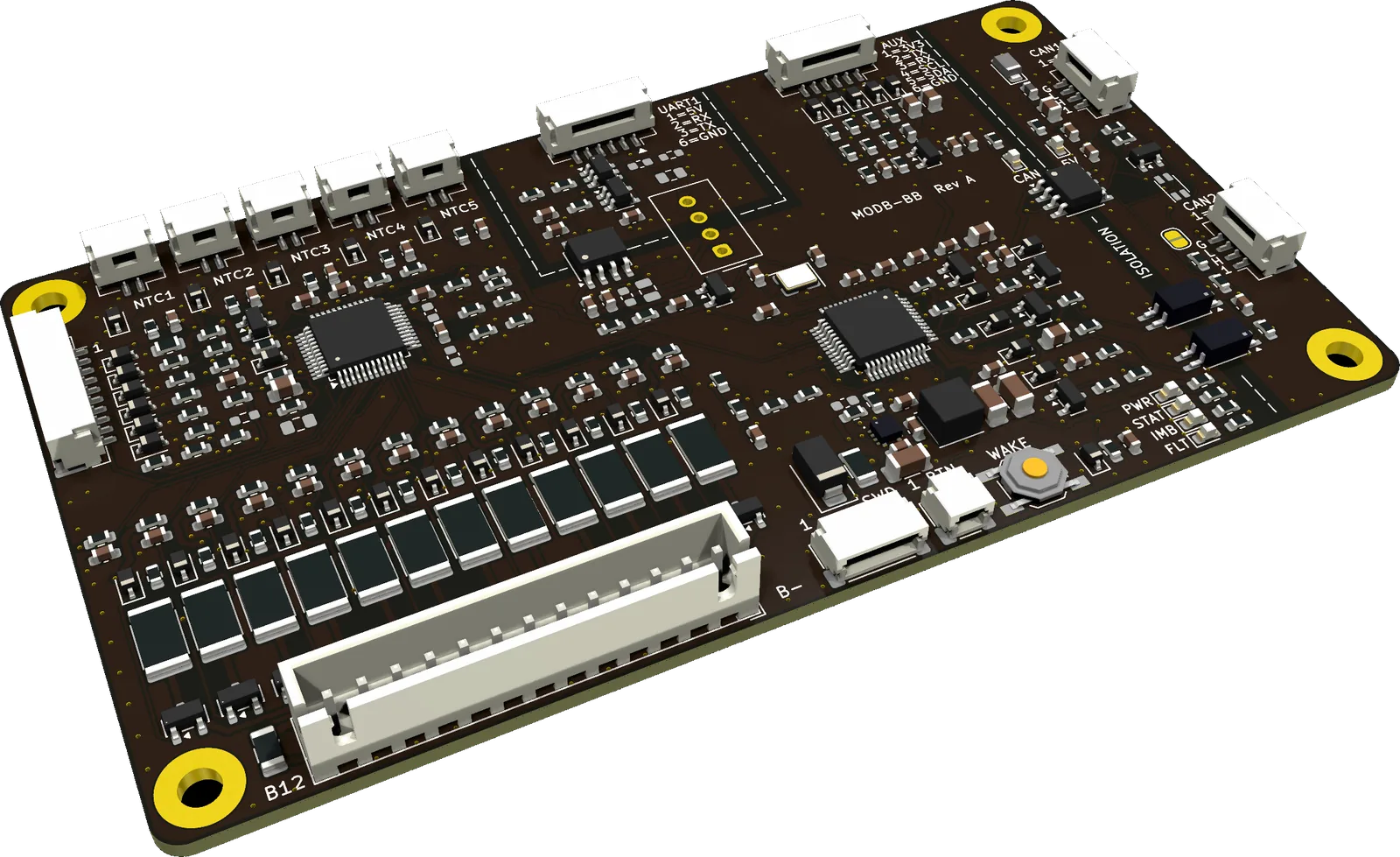
A drone battery is a stack of cells, and any one of them can fail first. MODB boards watch every cell, keep the pack balanced, and report it all to the controller that runs your machine — flight controller, robot or vehicle — over a standard, isolated CAN bus.
01 / Why it matters
Most flight controllers read one pack voltage from a power module. A weak, hot or drifting cell hides inside that number and shows up only as voltage sag under load — usually late in the flight, when it matters most.
MODB watches each cell on its own and puts that data on the bus the aircraft already uses. The flight controller can then act on the weakest cell, not the average.
02 / What a MODB does
A monitor, a balancer, a fuel gauge and a CAN node in one board. It carries no power switch, so it can never be the reason an aircraft loses power.
Every cell voltage, pack voltage and up to five temperatures, continuously. Accurate to ±5 mV per cell at 25 °C.
Bleeds the high cells so the pack stays even — during charge, at rest, even in sleep. No balance charger or host command needed.
Puts every cell, charge (SoC) and health (SoH) on the flight controller’s CAN bus as standard DroneCAN battery messages.
No power switch in the pack path. A BMS that cuts power in flight turns a cell warning into a crash. It detects and reports; your controller decides.
03 / Applications
Built first for drones, where a battery surprise ends a flight. The same board reports to any controller that needs to know what its cells are doing.
In the air
Build the board into the pack. Each pack reports its own cells, charge, health and cycle count to any aircraft it is plugged into.
Keep stock packs. Mount the board on the frame, plug in the balance lead, and the flight controller sees every cell.
The dock powers the CAN bus and the pack wakes by itself. Cell data and balancing run through the whole charge, with no one pressing a button.
One board per pack, all on one CAN bus. Each pack reports under its own ID, so the flight controller tracks every battery separately.
Beyond drones
Pack data straight into the robot controller over isolated CAN, so the controller schedules charging and derates on real cell data — not a guess from pack voltage.
24–44 V on one board · higher as stacked segments
Cell voltages, temperatures and pack current to your motor controller or VCU. The BMS reports; your controller or contactor acts, on rules you set.
MODB-SB · 100 A continuous measured · stack for 36–48 V
12 V and 24 V LiFePO4 on a single board, 48 V as two stacked. Telecom backup, portable power stations and solar storage that report every cell.
MODB-SB · 4S / 8S / 2 × 8S LiFePO4
Boards built for conformal coating, with the CAN side isolated from pack ground — useful when a vehicle shares one bus across several packs.
Either board · enclosure and sealing by you or the lab
04 / Made to fit your system
A locked, closed-box BMS decides your cell count, your limits and when your power goes off. MODB is configured for your battery and reports to your controller — and where the standard boards stop, the lab works out the right configuration with you.
05 / Which BMS do I need?
MODB-BB covers the big packs. MODB-SB is the compact board with current sensing built in. Answer three questions.
| Parameter | MODB-BB | MODB-SB |
|---|---|---|
| Pack size | 6S–12S | 3S–8S (stack for more) |
| Chemistry | LiPo · LiHV · Li-ion | Li-ion · LiFePO4 |
| Pack current | Plug-on module (planned) | On board · 100 A cont. · 150 A burst |
| Balancing | ~100 mA per cell, autonomous | 62 mA, or 170 mA external option |
| Temperature inputs | 5 NTC ports + board sensors | 4 NTC + shunt sensor |
| CAN | 2 × isolated, Pixhawk JST-GH | 2 × isolated, CAN FD |
| Ship-mode draw | 2–5 µA (design estimate) | < 10 µA |
| Board size | 109 × 62 mm | 105 × 68 mm |
| Status | Rev A · Alpha build | Rev A0 · fab-ready |
| Both | DroneCAN battery messages · ArduPilot and PX4 with stock parameters · SoC, SoH and fault log on the board · hardware fault detection · no power MOSFETs | |
Works with
06 / Modular by design
The base board does the essential job and nothing else. Current sensing, a Bluetooth link and a pack switch arrive as plug-on modules, so a simple system never pays for features it does not use.
07 / Coming soon · the link layer
A compact carrier board for Microhard pMDDL IP-mesh radios. Power from the flight pack; Ethernet, USB and telemetry on Pixhawk-style connectors.
08 / Who builds it
MODB and MODL each began as a problem we kept hearing from drone teams. The same six steps that produced them are how we work on yours.
How we workContact
Integration questions, alpha units, configurations for your application. Tell us the system, the pack and what you need to see.
Datasheets
Preliminary documents. Figures are design targets until measured on Alpha hardware.