
Sidekick + Weave · for hardware validation floors
Software-defined hardware needs
software-defined testing.
Two products that put your whole test floor on one timeline, and let any engineer share a moment of doubt in one click, with the machine context already attached.
- Environmental chambers·
- Battery cyclers·
- Motor and dyno rigs·
- HIL benches·
- EMC and EMI·
- Vibration and shock·
- Electronics benches
Your test floor works hard and keeps almost none of it.
Every rig is its own island.
A different vendor, a different screen, a different locked-down or air-gapped software. The cycler runs something from 2009 that change control will not let you touch. Nothing comes together, so no one ever sees the whole floor at once.
Effort and skill do not compound.
The same test gets rebuilt from scratch, runs get watched by hand, and the hard-won skill to read a rig leaves when the engineer does. The second programme costs what the first one did.
Sharing a problem loses the context.
When something looks wrong it becomes a photo, a Slack paragraph, and can you resend the log. By the time the right person looks, the moment is gone.
The log costs a day. Nobody opens it.
Results get transcribed into a report that takes a day to assemble and that no one reads until an auditor asks. Then the one number they want was never written down, and the run it came from was six months ago.
Three of these you can live with. The fourth is the one that costs you a week, because the answer was on a screen that nobody was reading.
Two products. One loop that compounds.
Sidekick captures reality at the rig. Weave correlates, shares and learns from it. And it flows back, so every run makes the next one cheaper.
- Capture/
- Correlate/
- Share/
- Learn/
- Act
Two ways in. No silo left out.
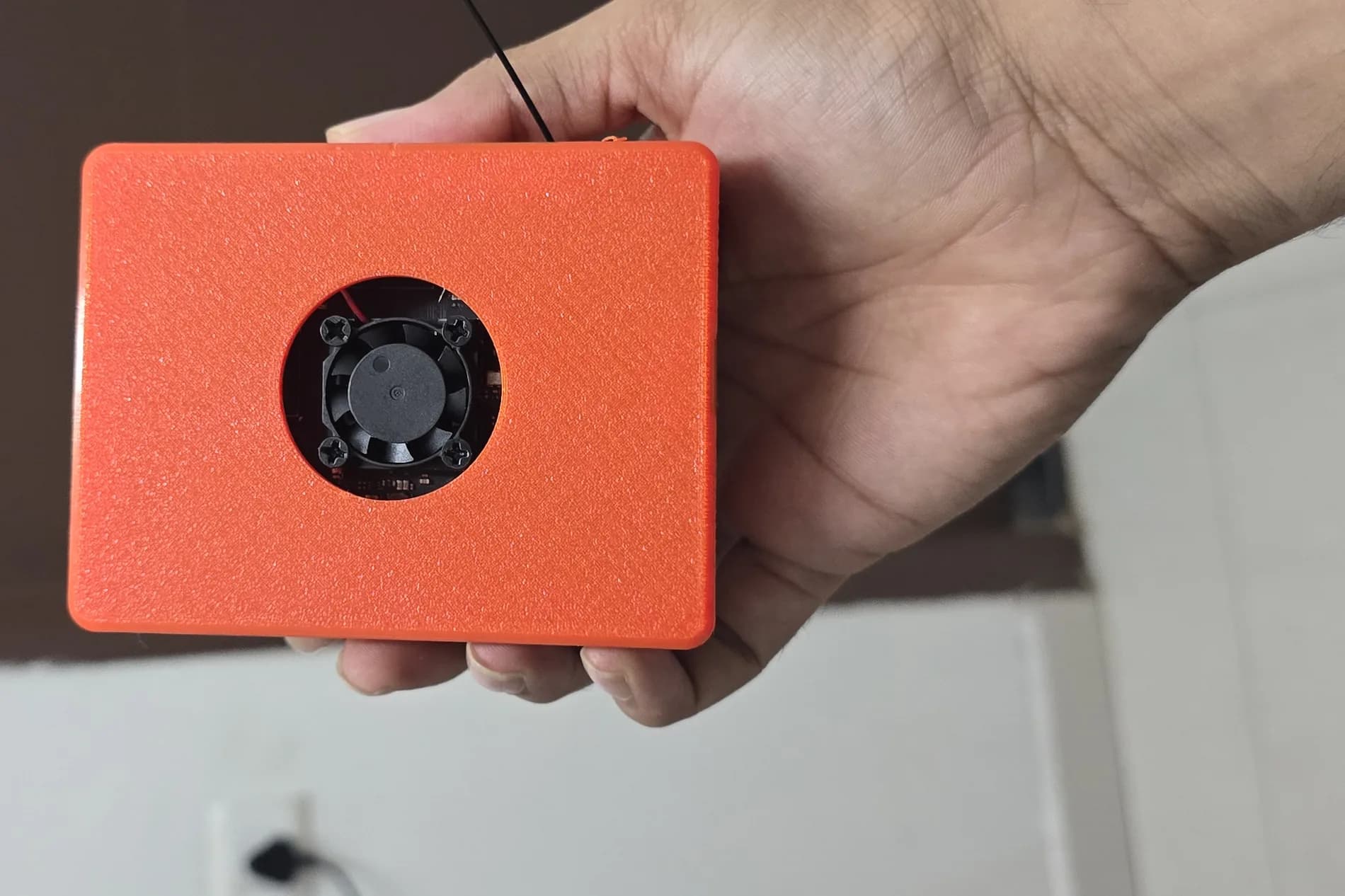
It all lands on the box first, so nothing leaves your network unless you send it, and it runs on an always-on rolling buffer. You capture the last few minutes after something happens, not before.
Screen-read · zero integration
Sidekick taps the instrument video out and reads the screen. Nothing installed, nothing to re-qualify. It works on any vendor, even locked-down or air-gapped rigs and software from 2009.
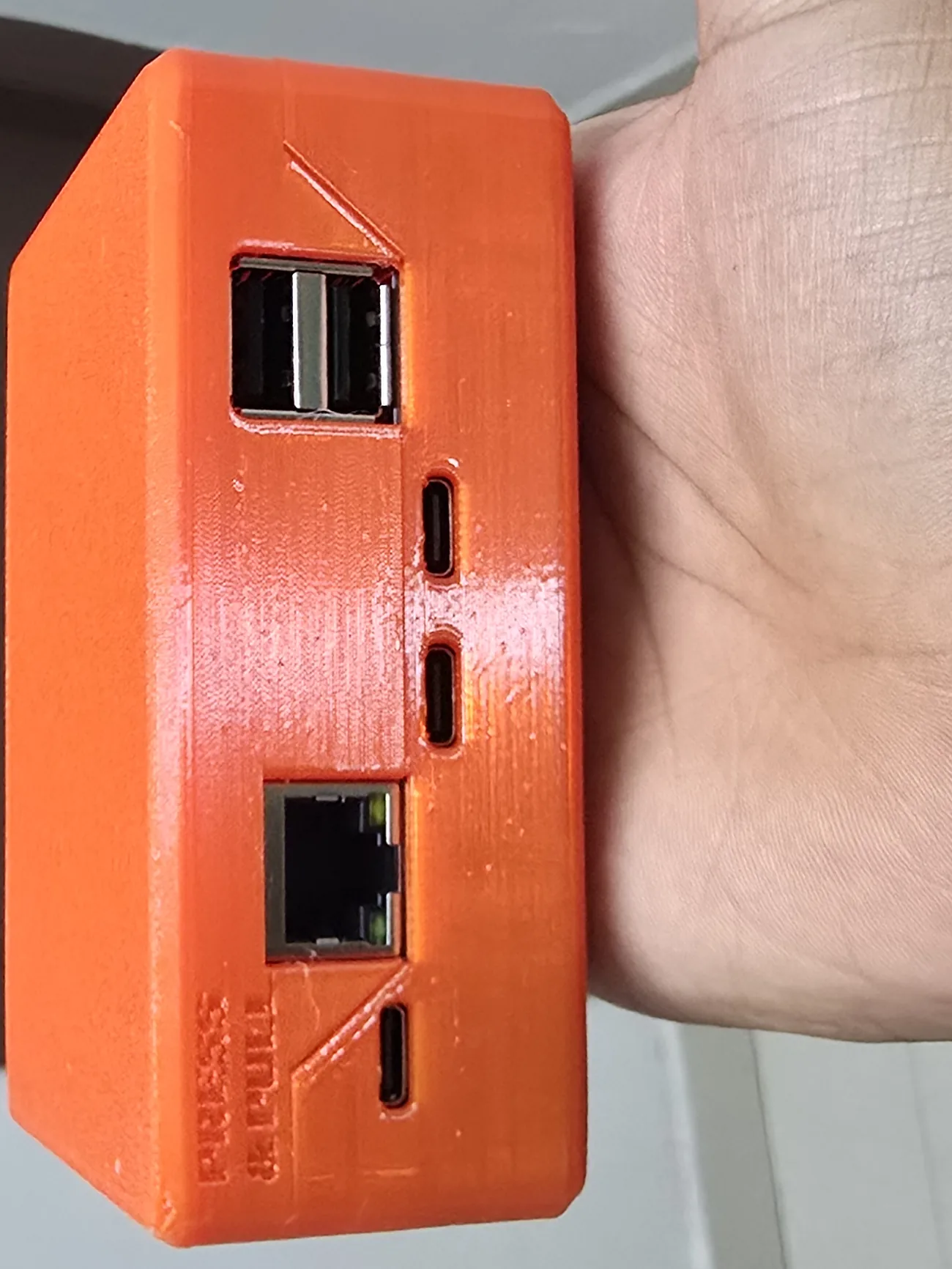
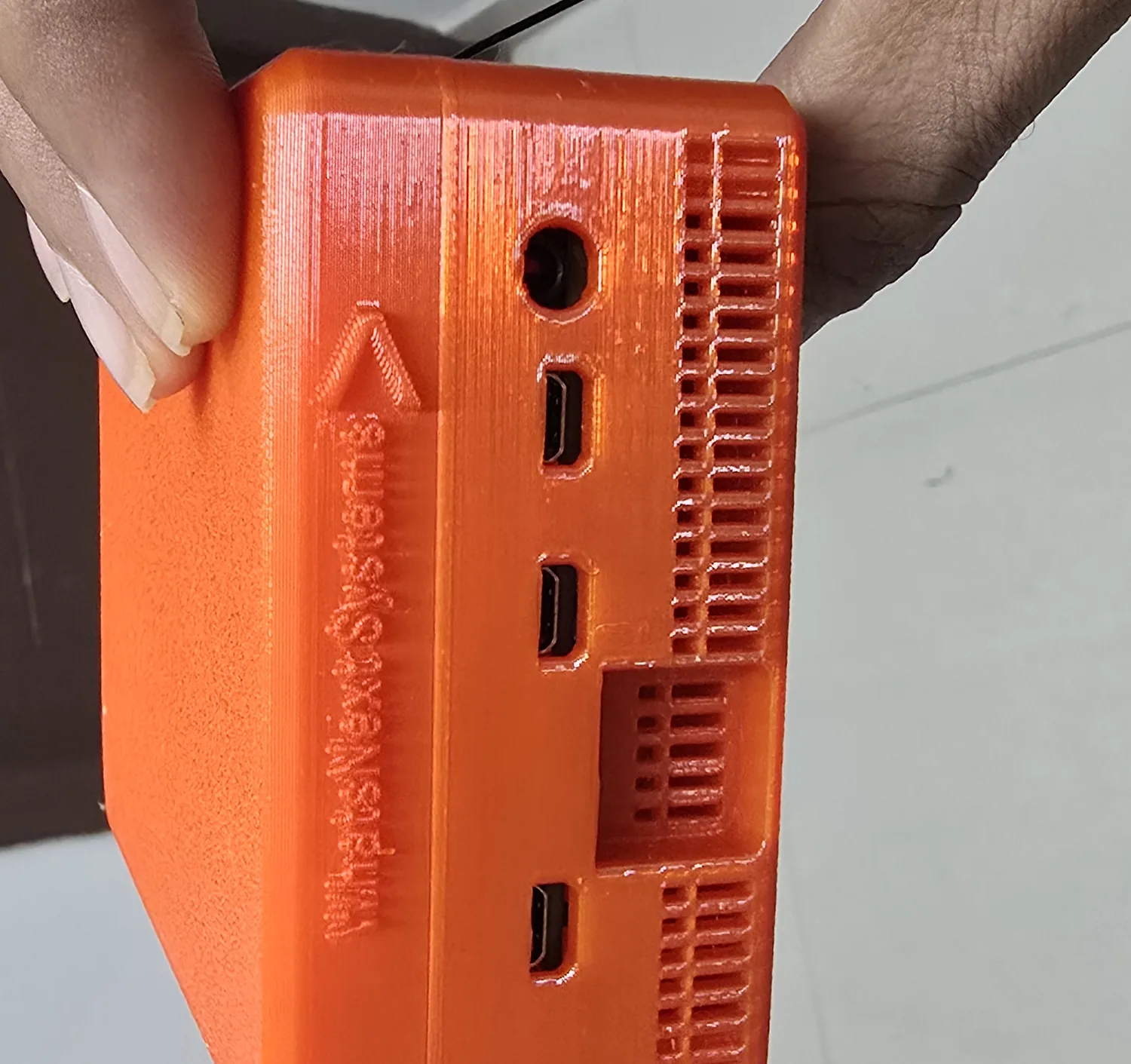
Connect · what you can reach
Passive taps and native connectors pull the signals you can: CAN, serial, RS-232 and RS-485, and telemetry streams. Read-only, so the wedge stays clean.
In: screen · CAN · serial · RS-232/485 · telemetry · voice
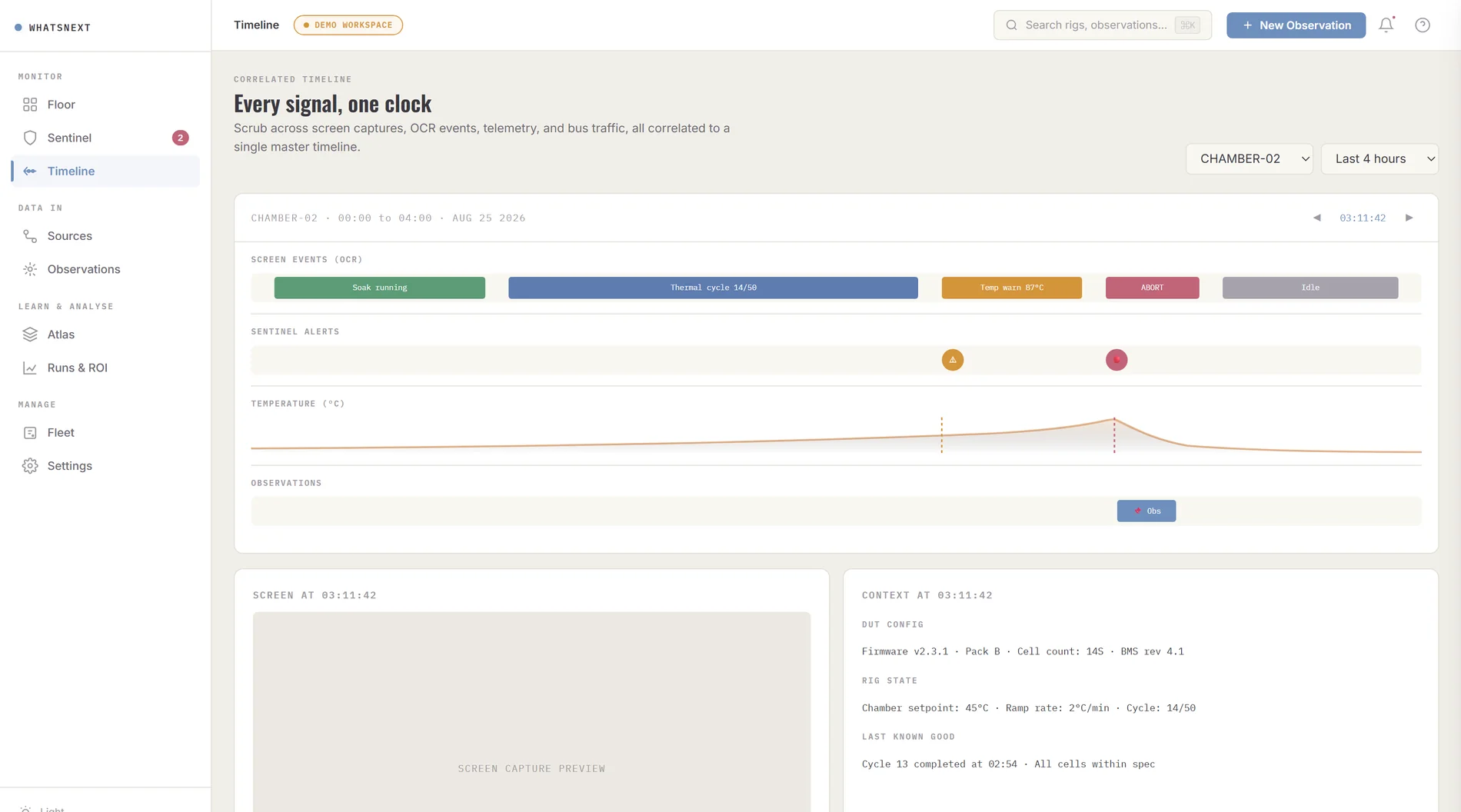
One correlated timeline
Everything streams to Weave on one clock, so the screen, the telemetry and the config on the unit line up at the moment you care about.
The workflow · like Loom, for hardware testing
Share a moment of doubt
in one click.
Sidekick is already recording the screen, the signals and the telemetry into a rolling buffer. So the moment you notice something, it has already been captured. You are not starting a recording, you are marking one.
Always on.
Sidekick is already recording the screen, telemetry and signals into a rolling buffer. You set up nothing.
Capture this.
One button marks the moment you want to share.
Narrate.
You talk through what looks wrong, and your screen for that window is grabbed with it.
Context attaches itself.
Weave adds the telemetry window, the signal traffic, and the exact config on the unit. Zero assembly.
One link.
A permalinked Observation, threaded to the right people.
They scrub the real thing.
Not a paragraph and a photo. The synchronized record of what you saw, said, and measured.
The artifact is called an Observation
Hour 41 of a 500-hour soak.
A cell voltage sags in a way your engineer has not seen before. Instead of a photo and a Slack message, they hit Capture and say what looks off. Weave bundles the last eight minutes of screen, their voice, the cycler and CAN telemetry around the sag, and the exact firmware on the pack. The BMS lead opens one link, scrubs to the sag, sees the config, and lands the root cause. The RCA starts from the full record, not a blank page and a can you reproduce it.
Illustrative scenario. We publish measured numbers only, once the first units run.
Observation · CYCLER-05 · 11:42
- voice note · 0:14
- soak · hour 41
- telemetry · last 8 min
- CAN log
- firmware v2.3.1
- config: pack B
shared to BMS lead · 3 on the thread
Your whole floor, on one screen.
Every Sidekick streams in. One live view across every rig and every vendor, results read straight off the instrument, and every Observation becomes a reusable, inspectable skill.
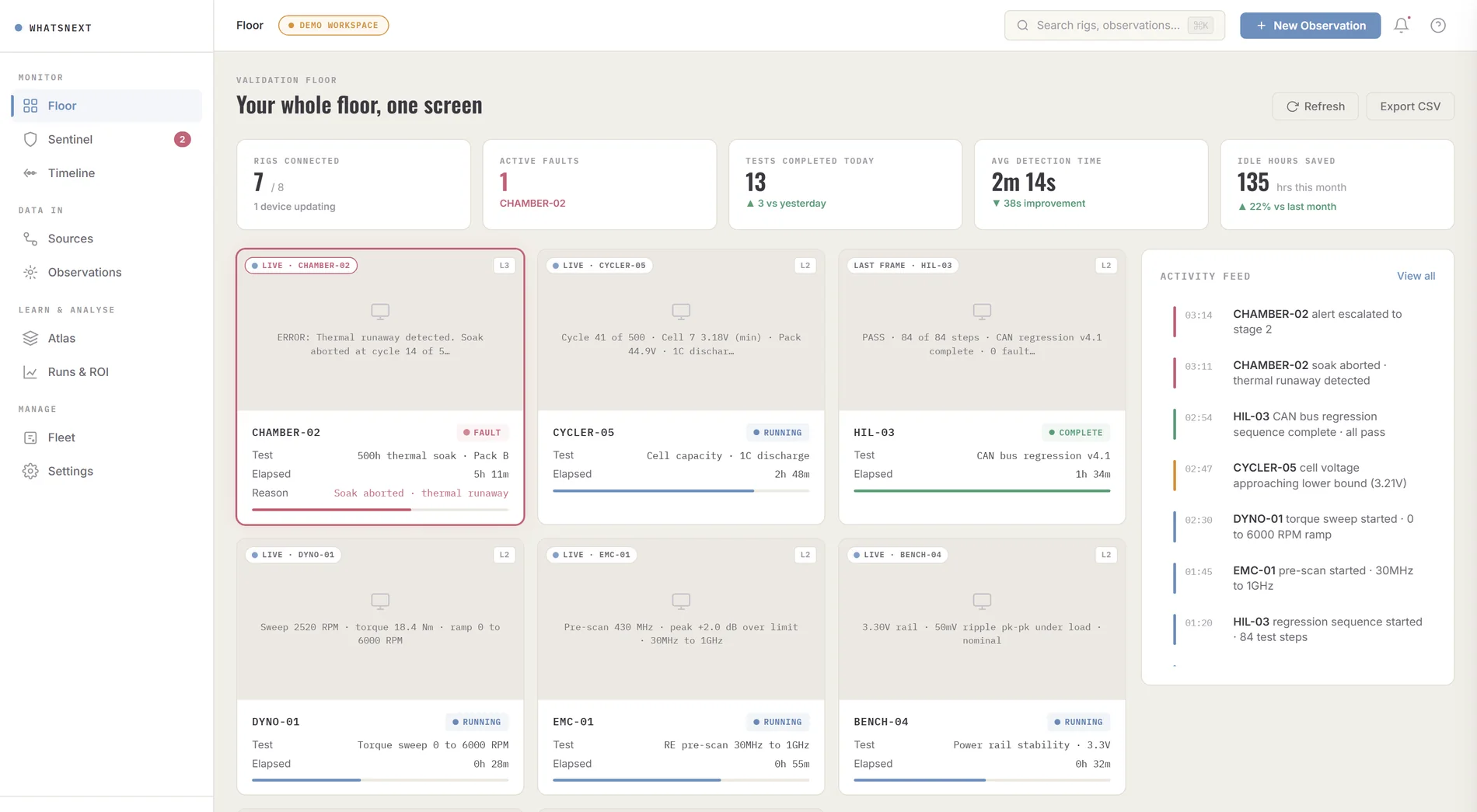
Two ways in. A memory that compounds.
Sources. Screen-read from Sidekicks, plus multi-vendor connectors for what you can reach.
Atlas. Every Observation becomes a reusable, inspectable skill, so the way one engineer reads a rig carries to the next rig and the next hire.
Built into your reliability loop.
FMEA / FMECA
Sidekick is a detection control. Continuous watch lowers the Detection rating, so high-RPN modes actually get caught.
DVP&R
Results auto-log to the record, traceable to the mode they verify. Templated setups reuse across the matrix.
Execution
EVT · DVT · PVT · HALT · soak · HIL
Live fault and state detection catches the mode the instant it triggers, out of band.
RCA
5-whys · fishbone · FTA
The Observation is the evidence package: screen, telemetry and exact config at the moment of failure.
8D / CAPA
The config ledger shows what changed, and golden-run comparison proves the fix. Traceable and audit-ready.
Observed occurrence and detection data flow back into the FMEA. Reliability grows, and it compounds.
What changes in your week.
Skilled time goes back to engineering.
Nobody sits and watches a run, and nobody types a reading into a spreadsheet. The reading is captured off the instrument, the fault reaches the engineer out of band, and their week goes to the problems only they can solve.
A proven setup stands up on the next rig in minutes.
The way one engineer set up a soak becomes a template anyone can reuse. Second programme, same test, minutes instead of days.
What your floor learns stays on your floor.
The know-how to read a rig lives in the system, not in one person. It carries to the next rig, the next programme, and the next hire.
The evidence package is already assembled.
When an RCA starts or an auditor asks, the screen, the readings and the exact config at the moment it happened are already together, timestamped and traceable. No blank page, no can you reproduce it.
Who is building this

Harit Trivedi
Founder, WhatsNext Systems
Lived, not studied.
Harit Trivedi has spent six years designing battery, power-electronics and embedded systems for drones, defence platforms and EV infrastructure: the exact instruments and rigs Sidekick reads. DVT, EVT and HIL floors are home, not a market studied from outside.
UAV BMS · 2,000+ units shipped
MIL-STD VTOL battery packs
45 kWh DC fast-charger architecture
In hardware, testing is your moat. Make yours the strongest.
Pick your worst silo, the rig that fails silently or ties up an engineer. We put a Sidekick on it, read-only, and you see the floor view in weeks.
- One rig, read-only/
- Floor view and alerts/
- Expand across the floor