
Weave · the hub
Your whole floor,
on one screen.
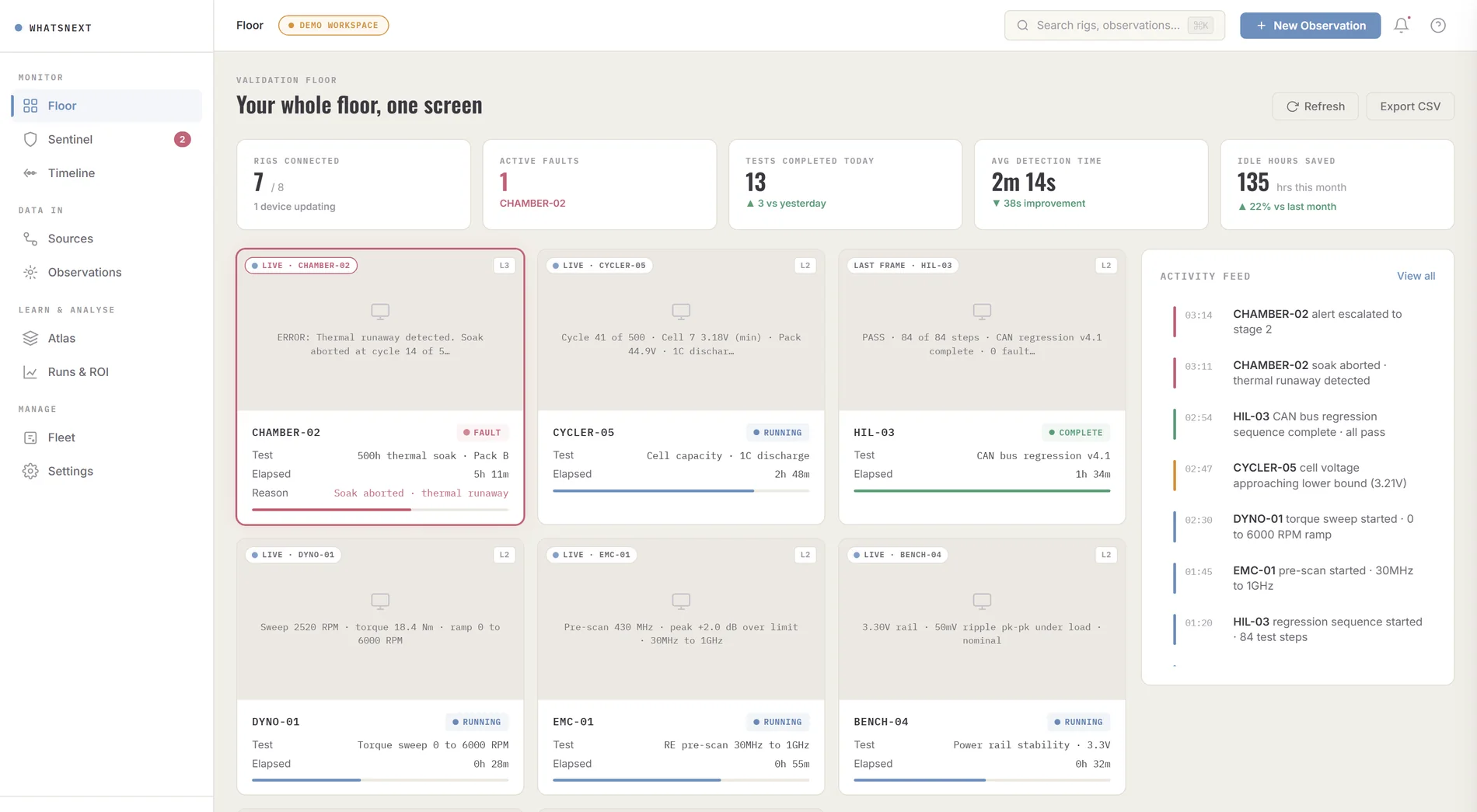
Every Sidekick streams in. One live view across every rig and every vendor, results read straight off the instrument, and the context the whole team sees at once.
One live view. Every rig, every vendor.
The chamber, the cycler, the HIL bench and the dyno do not agree on anything: not a file format, not a protocol, not a decade. Weave does not ask them to. It takes what Sidekick reads off each screen and puts the whole floor on one page, so the question of what is running right now stops being someone's afternoon.
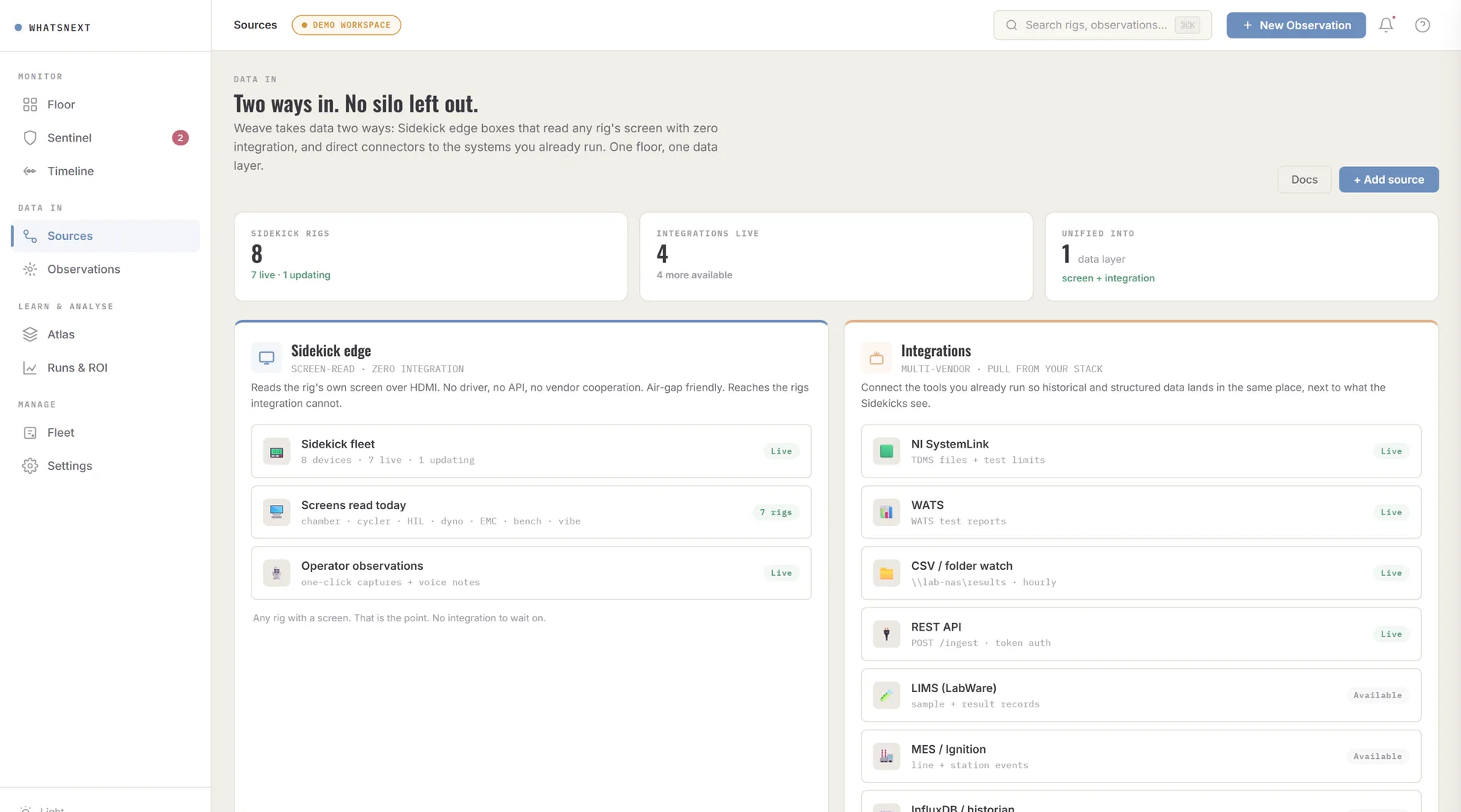
Two ways in. No silo left out.
Weave takes data two ways: Sidekick edge boxes that read any rig's screen with zero integration, and direct connectors to the systems you already run. One floor, one data layer.
Screen-read · zero integration
Sidekick edge
Reads the rig's own screen over the video out. No driver, no API, no vendor cooperation, and air-gap friendly. This is the half that reaches the rigs integration cannot.
Multi-vendor · pull from your stack
Integrationssoon
Connect the tools you already run, so historical and structured data lands in the same place, next to what the Sidekicks see.
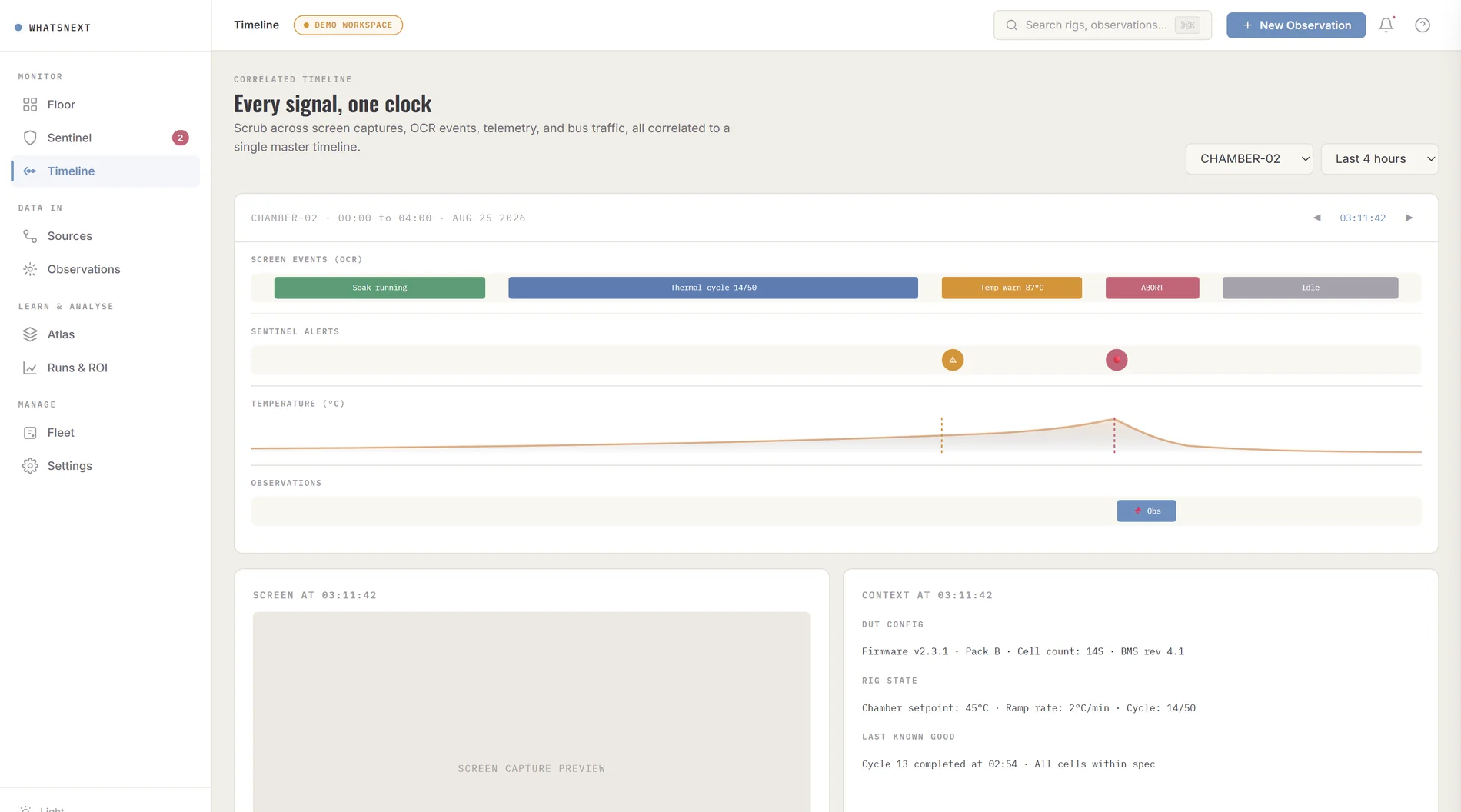
One correlated record, on one clock.
Screen, telemetry, signals and the exact config on the unit, lined up at the moment you care about. When an RCA starts or an auditor asks, the evidence is already assembled and already traceable. Nobody reconstructs a week from three spreadsheets and a memory.
One correlated timeline
Every source on the same clock.
DUT config ledgersoon
What was on the unit, and when it changed.
Auto cross-referencesoon
Related events surfaced across streams.
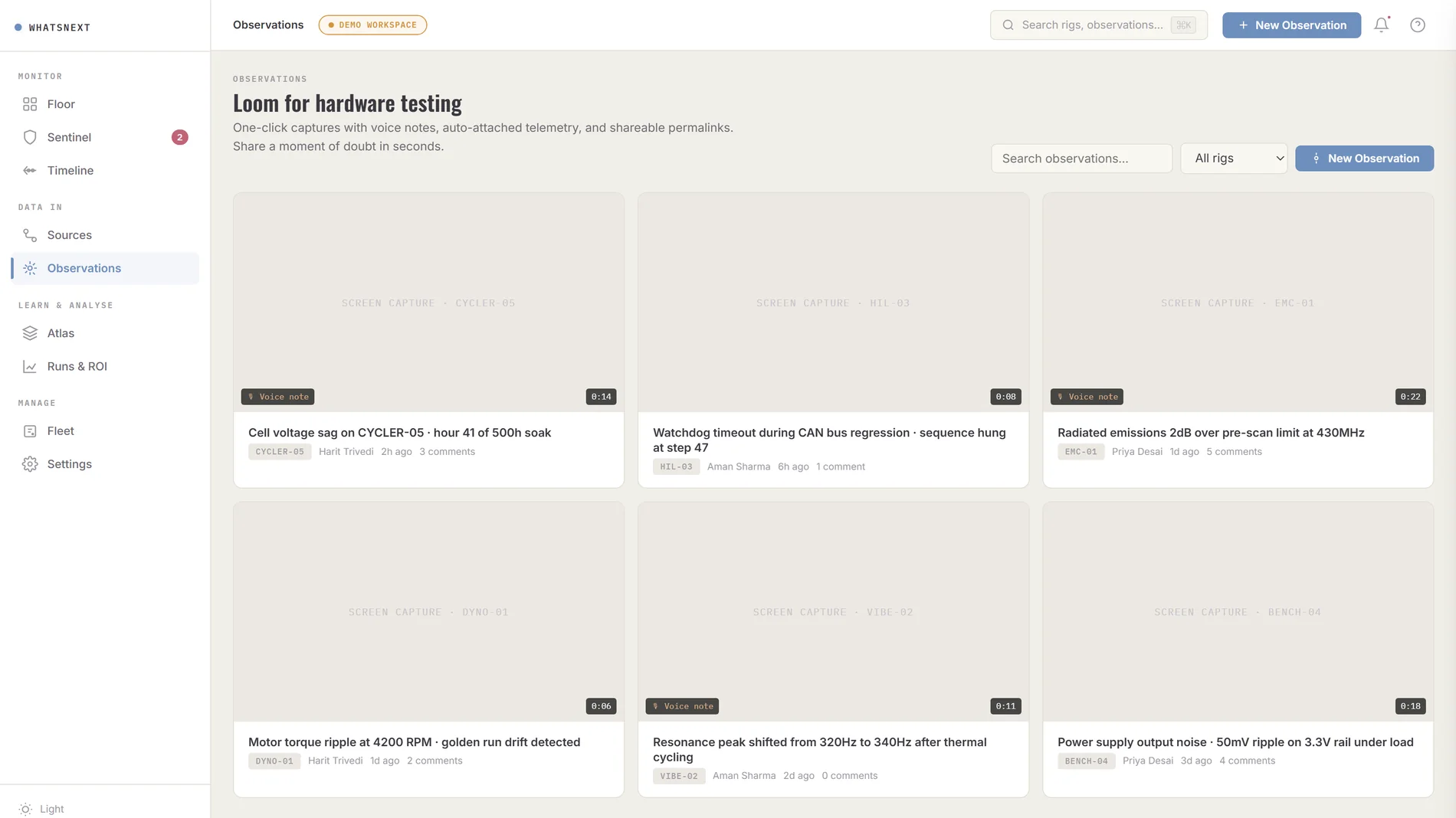
A moment of doubt, shared in seconds.
An engineer sees something they cannot yet explain. They hit capture and say what looks off. Weave attaches the telemetry window, the signal traffic and the exact config by itself, and hands back one link. The person who opens it scrubs the real thing rather than reading a paragraph and asking for the log.
One-click share
The moment, not a reconstruction of it.
Context attached automatically
Zero assembly on either end.
Bug reports with proofsoon
An Observation typed as a defect.
A memory that compounds.
Every Observation teaches Weave a reusable skill. When a Sidekick learns to read a rig, every other rig on your floor inherits it, and so does the next person you hire.
Intelligence in artifacts, not weights.
Open any skill and read the exact steps it runs. Edit it, or switch it off. Nothing here is a black box you have to trust, which is the difference between a system that compounds and a model that cannot explain itself.
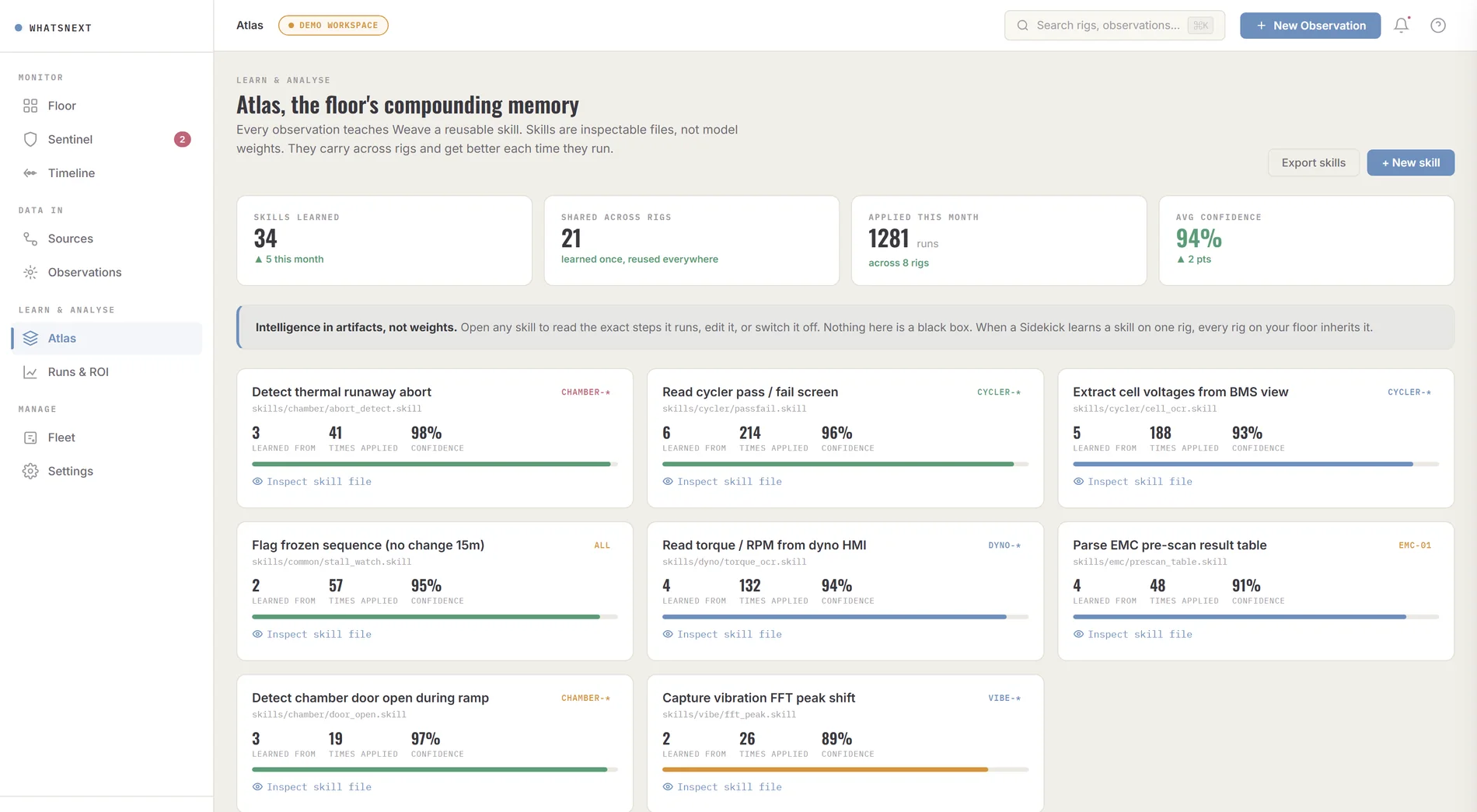
This is the part that makes the second year cost less than the first, and it is the part a dashboard cannot give you.
Why it pays, in your day.
Engineering effort
Minutes, not shifts
Stop rebuilding setups and watching runs by hand. Transfer full context in seconds instead of a photo and three follow-up questions.
Compounding learning
Skills that carry
Every Observation is reusable knowledge. The way one engineer reads a rig carries to the next rig and the next hire, instead of leaving with them.
A record that is used
The log gets opened
Results and evidence land in one place, correlated and searchable, and traceable to the exact config for audit.
Your data stays yours.
Local-first
Capture lands on the box. Nothing leaves your network unless you send it.
On-prem or your server
Weave runs where your data is allowed to be, including an isolated network.
Audit trail
Every Observation timestamped and linked to the exact config and telemetry.
You set access and retention
Who can see what, and how long it is kept.
Where Sidekick ends and Weave begins.
Sidekick answers what this rig is doing right now, and it has its own console for exactly that: configure the rig, draw a watch, read that rig's history. Weave answers what this organisation knows. Two products, and the second one is the reason the first one compounds.
See it before you talk to anyone.
The whole thing is clickable, with no form and no email. Open a rig, trip an alert, follow it into the timeline.